

Bunny was staring at his phone.
Not because he had received a message from his office crush.
Worse.
His Social Media University was exploding.
BIG CRASH COMING TOMORROW. SELL NOW!
Bunny asked,
“Investing Uncle, tell me honestly. What if the market crashes tomorrow? Should I invest today?”
I put down my Tea.
“Bunny,” I said, “the market may crash tomorrow.”
His face fell.
“And it may not.”
His face became more confused.
“Uncle, this is not helping.”
I replied,
“Welcome to investing, My Dear Bunny.”
Meet Our Story Characters
Our Hero - Bunny – 30 year old salaried guy, good at his job, but kind of clueless when it comes to managing money.
The Guide - Investing Uncle - Calm, wise, and funny. The kind of uncle who explains money over Tea and not Powerpoint slides.
The Uncomfortable Truth
Nobody - not your favourite analyst, not the person who forwards 17 market predictions before breakfast - can reliably know exactly when a crash will begin.
A crash tomorrow is a possibility, not a prediction you can safely build your financial life around.
So for an investor, the better question is…
“Can I invest in a way that remains manageable if the market falls sharply?”
That question changes everything.
Because investing today and experiencing a crash tomorrow are not automatically the same thing as making a bad investment.
Your experience depends on…
What you buy
How much you invest
When you need the money
How diversified you are
How much risk you can actually tolerate
Whether you have enough financial safety outside your investments
In Uncle’s words…
“Don’t ask the market to behave. Build a financial plan that doesn’t require the market to behave.”
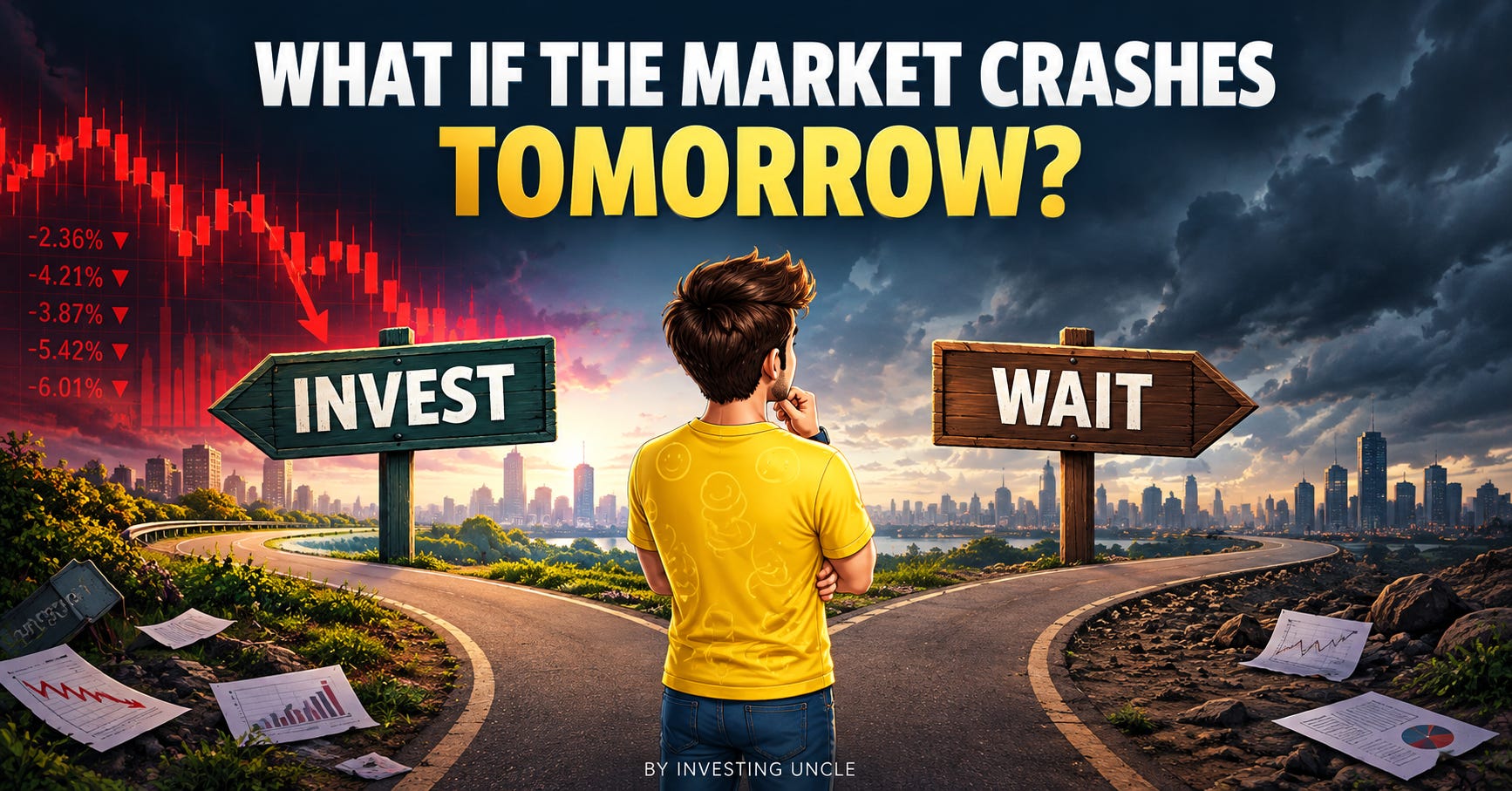
“What if I invest and immediately lose money?”
Bunny had a very reasonable fear.
Suppose he invests Rs. 1 lakh in a diversified equity fund.
Next week, the market falls sharply.
His ₹1 lakh becomes ₹70,000.
“Oho!” Bunny says. “I lost ₹30,000!”
“On paper, yes,” I say. “But your investment has fallen in value. You haven’t necessarily locked in that loss unless you sell.”
“But Uncle, seeing ₹70,000 where I put ₹1 lakh is painful.”
“Of course. Even I don’t enjoy seeing my Tea become cold.”
A fall from ₹100 to ₹70 is a 30% decline.
If you sell at ₹70, the loss becomes permanent.
If you don’t need the money and remain invested in a suitable long-term investment, the future outcome is still unknown. The investment could recover, take a long time to recover, or perform poorly.
That’s why we should never say, “Market always comes back, guaranteed.”
There are no guaranteed equity returns.
But history does show that Indian markets have experienced severe draw-downs - including the global financial crisis and the COVID era crash and subsequently reached new highs. That is useful historical perspective, not a promise about what will happen next.
I asked Bunny one question
“When do you need this money?”
“Next year,” Bunny said.
“Bunny, your problem is not the stock market. Your problem is the calendar.”
Your goal decides how much market risk makes sense.
If you need money within the next few months - or potentially within the next few years - putting that money heavily into equities can create a serious risk of having to sell after a fall.
For many investors, equity becomes more suitable when the goal is 5-7-10+ years away, because short-term crashes have more time to become just one part of a much longer journey.
But even over 10 years, equity can lose substantial value and returns are never guaranteed.
Time helps. Time does not make investing risk-free.
Don’t invest your emergency fund
Your emergency reserve should be kept separately for things like…
Rent or home expenses
Food and utilities
Medical expenses
Job loss
Unexpected family responsibilities
Insurance deductibles
Urgent repairs
The exact amount depends on your household, income stability, dependants and expenses. Many households aim for several months of essential expenses.
“Should I invest everything today?”
“No,” I said.
“Then should I wait for the crash?”
“Also no.”
Bunny looked offended.
“Uncle, please give me one answer.”
“Fine. Here’s the answer:
Invest according to A PLAN, not according to tomorrow’s headline.”
There are two dangerous extremes…
Extreme 1: “I must invest everything now!”
This can create regret and panic if markets fall immediately.
Extreme 2: “I’ll wait until the perfect crash.”
The problem?
You don’t know when the crash will come.
It may come next week.
It may come two years later.
It may not come in the dramatic form you imagined.
And even if you correctly predict a fall, you still have to know when to get back in.
That’s two predictions.
Good luck with that.
Bunny discovers the superpower of boring investing
For money genuinely available for long-term investment, Bunny could consider gradually investing rather than making every decision based on fear.
That’s where SIP or STP can be useful.
One of the useful effects of SIP or STP is - you naturally buy at different prices instead of betting everything on one entry point.
But remember…
SIP or STP does not guarantee profits.
It is a discipline and cash-flow method, not a magic.
Asset allocation beats market astrology
I showed Bunny two imaginary portfolios.
Portfolio A
₹10 lakh entirely in equities.
During a severe market decline, it could experience a very large temporary fall.
Portfolio B
₹7 lakh in equities + ₹3 lakh in relatively lower-volatile assets.
Its response to the same equity-market fall would generally be different.
But Portfolio B may also have lower potential long-term returns than a portfolio with more equity.
Neither portfolio is automatically right.
The appropriate mix depends on your…
Age
Income stability
Financial responsibilities
Emergency savings
Existing investments
Debt
Goal
Time horizon
Ability to tolerate losses
This is asset allocation in simple language:
Don’t put all your financial eggs in one emotional basket.
“But Uncle, can I really handle a 30% fall?”
Risk tolerance isn’t just asking…
“Can I handle a 30% fall?”
Ask yourself…
Would I panic if ₹5 lakh became ₹3.5 lakh?
Would I sell because I feared losing more?
Would I need this money during the downturn?
Can my income continue if the economy slows?
If a temporary fall would force you to sell, your portfolio may contain more risk than you can practically tolerate.
The right portfolio is not the one that looks impressive in a bull market.
It is the one you can actually stick with when the newspaper becomes dramatic.
Ignore Social Media
Please be careful with…
“Crash guaranteed tomorrow!”
“Market will double this year!”
“Guaranteed 100% return!”
“Insider information!”
“Buy before everyone else!”
If someone can consistently predict every market top and bottom, they probably don’t need any social media account.
Both fear and FOMO are expensive financial advisors.
Bunny remembers an old lesson
I reminded him about our earlier conversation…
Why Your SIP Returns Are Lower Than Expected.
…that lesson was not just about returns.
It was about expectations.
Investing is not about finding an investment that rises every month.
There will be good years.
Bad years.
Boring years.
Years when your portfolio makes you feel like the best investor.
And years when it makes you question your life choices.
The wisdom is learning to judge your investment plan by your goal, time horizon, costs, diversification and risk, rather than by one year’s return.
Mutual-fund expenses (expense ratio) matter too. Costs reduce the return that ultimately reaches you, so understand what you’re paying.
And please don’t collect 15 mutual funds just because each one has a different advertisement.
You don’t need a museum of mutual funds.
You need investments, financial products and mutual funds that you understand.
The Five Questions Before You Invest Today
I gave Bunny a final checklist.
1. When will You need this money?
₹3 lakh needed next year is not the same as ₹3 lakh needed for retirement 25 years from now.
2. Can I survive financially if this investment falls 30–40%?
Not emotionally.
Financially.
3. Do I have an emergency fund?
If not, fix the foundation first.
4. Am I diversified?
Understand what you actually own and what risks remain.
5. Am I following a plan - or reacting to fear, gread and FOMO?
If you cannot answer these questions, pausing to make a plan can be more useful than rushing into the market.
Slow down.
Understand first.
Then invest.
Bunny finally understood
“Uncle,” Bunny said, “so you’re not telling me whether the market will crash tomorrow.”
“No.”
“And you’re not telling me to invest everything today.”
“No.”
“Then what are you telling me?”
I smiled.
“I’m telling you that you don’t need to predict tomorrow to make a sensible decision today.”
The market is unpredictable.
So focus on what you can control…
Time horizon.
Diversification.
Regular investing.
Risk management.
Costs.
Discipline.
The question isn’t…
“Will the market crash tomorrow?”
The better question is:
“If it does, will my financial plan survive?”
Bunny’s answer was finally yes.
Not because he knew what the market would do.
Because he knew what he would do.
And that’s when he stopped being a nervous spectator and started becoming a better investor.
“Don’t try to predict tomorrow’s market; make today’s money decision so sensible that tomorrow’s market can’t bully you.”
Now it’s your turn.
Would you invest today if you knew the market might crash tomorrow - or would you wait?
And what matters more to you: getting the perfect entry price or building a plan you can stick with?
Tell me in the comments.
If this Tea break conversation helped you see your money a little more clearly, SUBSCRIBE NOW.
See you Every Sunday at 09:15 AM.