

Bunny slumped into his chair, scrolling through his mutual fund app for the fifth time in the week. The stock market had been coming down and down and down.
“Uncle…” he muttered under his breath, “I invested in this tech fund, then a pharma fund and a thematic one too. Now, every time, I am just thinking about my NAVs! Did I make a mistake? Should I sell everything before I lose it all?”
If you’ve ever felt like Bunny, welcome to the club. Many middle-class investors in India invest in equities without fully understanding the risks involved. It’s confusing, emotional, and often overwhelming. But don’t worry, by the end of this blog, you’ll see how you can invest in equity mutual funds calmly and confidently, without losing sleep or money unnecessarily.
Meet Our Characters
Hero: Bunny - confused, anxious, worried about losing money.
Guide: Investing Uncle - calm, experienced, humorous, and wise, always ready with practical advice.
The Problem
Bunny had done what many of us do - he saw a few funds performing well last year, put his savings into them. Now, with the market swinging wildly, he was panicking.
“Uncle, every day my funds are getting red, redder and reddest, and I feel like I’m on a roller-coaster without a seat-belt. How do I even make sense of this?”
His problem was real. Equity mutual funds are inherently “risky,” and the way most new investors approach them - chasing returns, reacting to every news alert, and ignoring diversification - amplifies risk.
Guide Appears - Investing Uncle Steps In
I poured him a cup of Tea. “Bunny, calm down,” I said. “Equity mutual funds are like traffic on Delhi roads. Chaotic, yes, but with a proper route and a little patience, you reach your destination safely. Let me guide you through a simple, smart way to reduce risk without giving up on potential growth.”
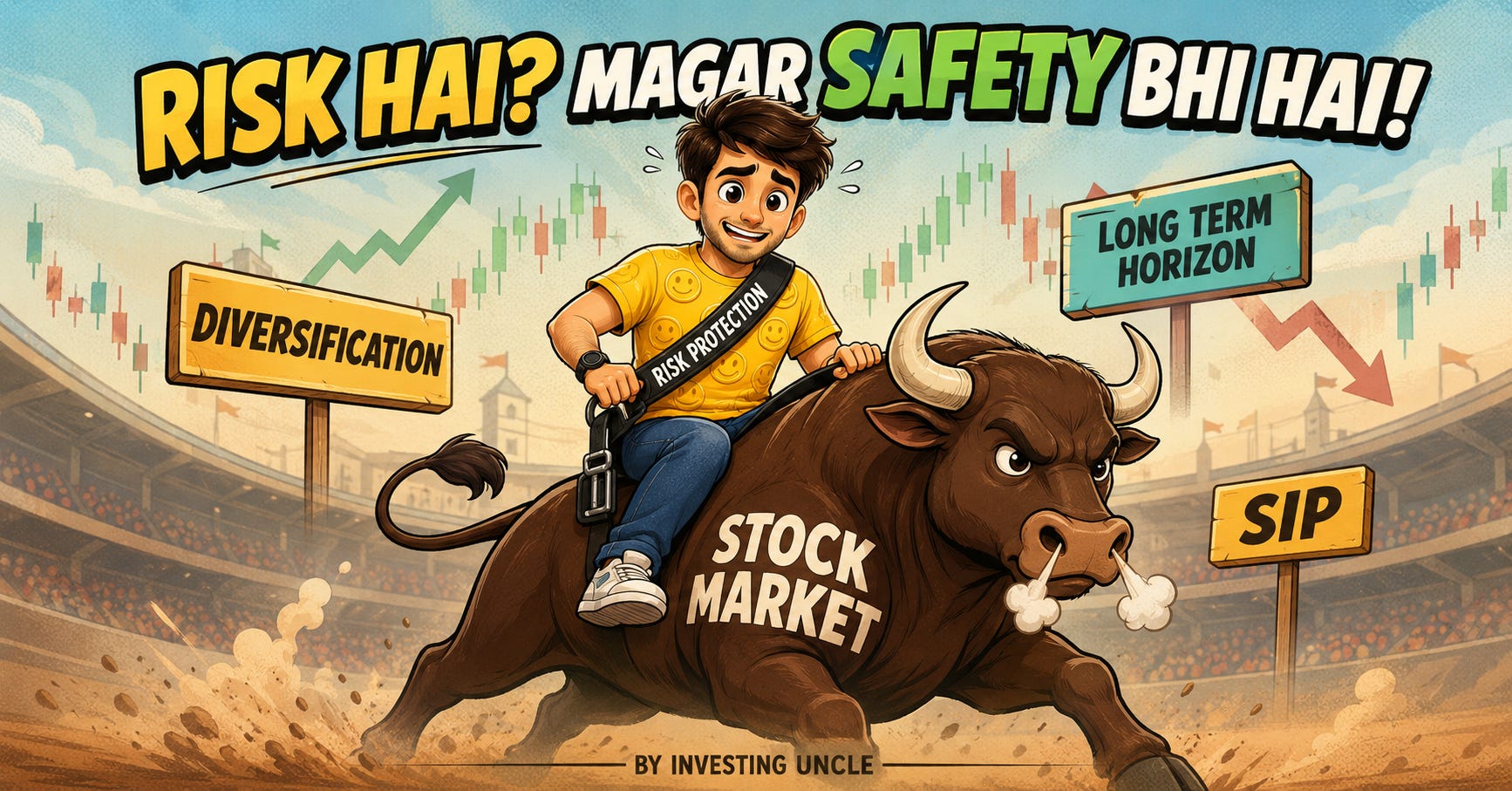
Plan Given: Step-by-Step Guide to Reduce Risk
Here’s the ultimate road-map Bunny that you can follow to manage equity mutual fund’s risk:
1. Diversify, Diversify, Diversify
Don’t put all your money in one fund or one sector.
Spread investments across large-cap, multi-cap and/or balanced funds.
Think of your portfolio like a cricket team: you need batsmen, bowlers, and fielders.
Why it works: If one fund crashes or is not performing, other parts of your portfolio may cushion the fall.
2. Use SIPs (Systematic Investment Plans)
Instead of investing a lump sum, invest a fixed amount regularly (monthly or quarterly).
This is called rupee-cost averaging. When markets are down, your fixed amount buys more units; when markets are up, it buys fewer.
Why it works: It smooths out market volatility and reduces the stress of trying to time the market.
3. Invest in Diversified Funds, Not Sectoral or Thematic Funds
Multi-cap, large-cap, flexi-cap or balanced funds are generally safer than sector-specific or thematic funds.
Example: A tech sector fund might skyrocket one year but crash the next.
Why it works: Diversification within the fund reduces the impact of sector-specific risks.
4. Check Historical Performance During Downturns
Look at how the fund performed in past market crashes or corrections.
Funds that recover well during downturns often indicate strong fund management and resilience.
5. Opt for Large-Cap or Multi-Cap Funds if You’re Risk-Averse
Large-cap companies are stable and reliable - like our trusted Maruti.
Multi-cap funds balance safety and growth, investing across small, mid, and large companies.
6. Have a Long-Term Investment Horizon
Equity is volatile in the short term. Don’t panic if markets dip.
Stay invested for at least 5-10 years to benefit from compounding and market recovery.
7. Avoid Chasing Last Year’s Top Performer
Past performance does not guarantee future returns.
Focus on consistency and fund stability rather than hype or social media trends.
8. Understand the Fund’s Risk Grade
Mutual funds provide a risk grade: aggressive, moderate, or conservative.
Choose funds that match your risk tolerance, age, and financial goals.
9. Limit Exposure to Aggressive or Sectoral Funds
Keep only a small portion of your portfolio in Sectoral funds.
Aggressive bets can pay off, but they can also cause sleepless nights.
10. Re-balance Your Portfolio Periodically
Review your investments once a year.
If equity funds have grown faster than debt funds, sell some units of equity mutual funds and invest in debt funds to maintain your desired risk level and Asset Allocation.
11. Check the Fund Manager’s Experience
Experienced fund managers usually handle market volatility better.
A capable manager can make disciplined decisions during downturns, protecting investors from unnecessary losses.
12. Invest Only Money You Won’t Need Soon
Equity is best for long-term goals (5–10 years, longer the better).
Short-term withdrawals increase the risk of locking in losses.
13. Stay Invested During Market Dips
Panic selling is the fastest way to lose money.
Historically, investors who stay invested through corrections recover and grow wealth over time.
14. Consider Hybrid Funds for Moderate Risk
Equity-oriented balanced funds mix equity and debt, giving moderate growth with lower risk.
Suitable for investors who want exposure to equity but cannot handle high volatility.
15. Keep an Emergency Fund Separate
Never rely on equity funds for short-term needs.
A separate liquid buffer prevents forced withdrawals in downturns.
16. Educate Yourself About Markets (like reading Investing Uncle’s Blogs)
Markets go through ups and downs. Understanding cycles and stock market in general, reduces fear and impulsive decisions.
17. Avoid Over-Diversification
Investing in too many funds can dilute returns.
Aim for 3-5 high-quality equity funds rather than spreading across 15+ funds.
18. Track Expense Ratios and Hidden Costs
High expense ratios eat into returns (Read: Expense Ratio in Mutual Funds: The Silent Fee That Shrinks Your Returns).
Choose direct plans and low-cost funds.
19. Stay Disciplined and Ignore Noise
Ignore daily news, social media tips, or hot fund picks.
Discipline and patience are your best friends in equity investing.
Bunny Sees His Future Clearly
Bunny leaned back, a small smile forming. “Wait… so if I diversify, use SIPs, check risk grades, stay invested, and re-balance, I can reduce risk significantly? I can actually sleep at night while my money grows?”
“Yes, Bunny!” I said. “You’ll feel calmer, your portfolio will be healthier, and your long-term wealth creation will be smoother. No more panic at 2 AM!”
Bunny Becomes Smarter, Calmer, and In Control
Bunny now had a clear road-map: a mix of large-cap, multi-cap, and hybrid funds, disciplined SIPs, and a long-term horizon. He felt in control, confident, and surprisingly happy about his equity journey.
Reader = Real Hero
If Bunny can do it, so can you. Even small, consistent steps - like SIPs, diversification, and staying disciplined - can dramatically reduce equity risk. You don’t need to be a financial wizard to protect and grow your wealth.
And remember to also read…
“Child’s education vs your retirement - which goal should come first?”
…Understand how to balance priorities and build wealth over decades.
“Investing without a plan is like riding a scooter in Delhi rain without brakes - slippery, scary, and should be totally avoided”.
Got some clarity? Hope this blog adds real value to your long-term wealth creation journey.
If YES, maybe you treat Uncle with a cup of Tea.
Comment below your biggest investing fear, subscribe for more practical wisdom, and see you Next Sunday at 09:15 AM.
Disclaimer: Mutual fund investments are subject to market risks, read all scheme related documents carefully before investing. The past performance of the mutual funds is not necessarily indicative of future performance of the schemes. Investors are requested to review the prospectus carefully and obtain expert professional advice with regard to specific legal, tax and financial implications of the investment/participation. This blog/Website is for Educational purpose only. Any reference should not be treated as any form of Financial Advice.
Any person referred to in this post is purely coincidental. The characters, names, and situations mentioned are for illustrative and educational purposes only and are not intended to represent any real individual.
‘Investing Uncle’ is NISM Series V-A Certified (Mutual Fund Distributor’s Certification Examination) conducted by National Institute of Securities Markets (NISM).
Investing Uncle is not SEBI/AMFI Registered.