

One Sunday morning, Bunny walked into my house looking like he had just discovered a treasure map.
Bunny: “Uncle! I’m thinking of putting ₹5 lakh into Equity mutual funds. But tell me honestly… how much return will I get? 40% annually for sure, right?”
I nearly spilled my tea. “Bunny, if mutual funds could guarantee 40% annual returns, I’d be living in a beach house in New Zealand right now, not sitting here answering your question.”
Our Hero & Guide
Bunny, our hero, is like many middle class Indian investors - excited, hopeful, but expecting a shortcut.
I, your humble Investing Uncle, am the guide - with tea in hand, a smile on my face, and money truths explained with warmth and humour.
The Problem
Bunny had seen a few flashy Social Media posts, and overheard his neighbour brag about “40% mutual fund returns.”
Now he thinks mutual funds are like a fixed deposit - predictable, guaranteed, and steady.
I listen and smile
I let him finish his speech and then said:
“Remember last week we spoke about how money is emotional before it’s logical? The same applies here. The market and mutual funds has mood swings - sometimes happy, sometimes cranky. Your returns dance to that same rhythm.”
A Simple Framework
Step 1: Accept there are no guaranteed returns.
Mutual funds are market-linked. They can go up and down quickly.
Past performance is not a promise of future returns.
Even the best fund manager can’t stop a market decline.
Step 2: Understand what affects your returns.
Market Conditions: A booming economy can lift equity funds; a slowdown can drag them down.
Fund Type / Asset Allocation:
Equity funds: higher risk, higher potential returns.
Debt funds: lower risk, lower returns.
Hybrid funds: a balance of both.
Fund Manager’s Skill: For active funds, a skilled manager can make a difference.
Expense Ratio: Annual fees that slowly eat into returns.
Investment Horizon: Staying invested for 5–10 years smooth’s out market volatility.
Risk Appetite: High potential returns come with higher risks - and bigger short-term drops.
Diversification: Spreading investments across different funds/assets reduces risk.
Economic Factors: Inflation, interest rates, government policies, and global events all matter.
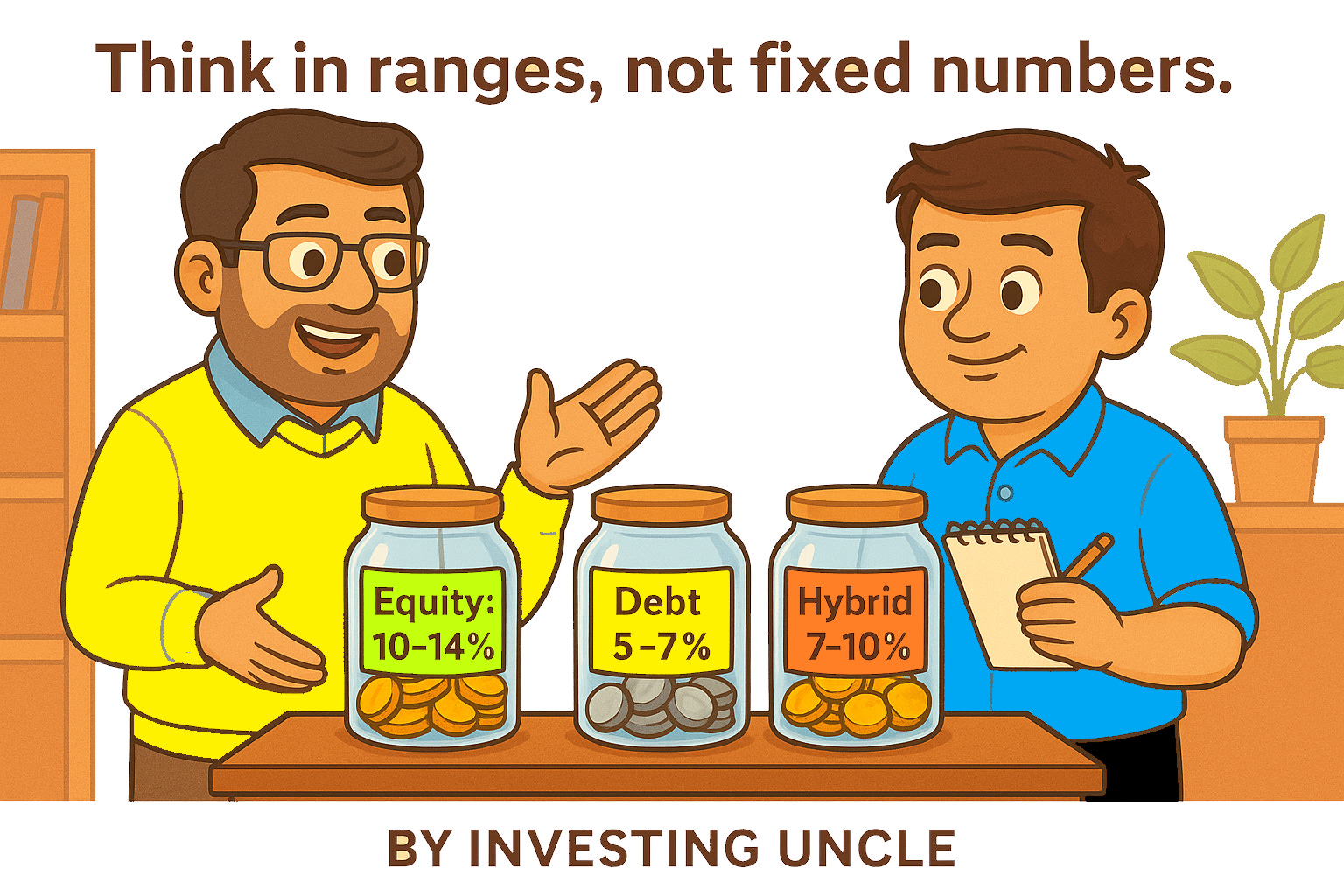
Step 3: Think in ranges, not fixed numbers.
Equity mutual funds: 10–14% over the long term (7+ years).
Debt funds: 5–7%.
Hybrid funds: 7–10%.
I told Bunny:
“Equity investing is like planting a mango tree. If you care for it for a decade, you’ll have enough fruits to enjoy and share.”
Bunny realised that expecting a fixed number was like expecting the weather to be exactly the same every day - impossible.
Transformation – Bunny becomes smarter
Bunny’s excitement turned into curiosity.
He opened an SIP calculator on his phone.
“Uncle, so if I invest ₹10,000 every month for 10 years, at 12% expected return, I might get around ₹22,40,359… but this is only an estimate, right?”
I nodded. “Exactly. A calculator is for planning, not predicting. And in 20 years, you may get ₹91,98,574. Again, an estimate!”
If Bunny can move from “40% guaranteed” to “10–14% over the long term,” so can you.
You don’t need rumours or unrealistic promises. You need:
Goals matched with the right fund type.
The patience to stay invested.
A focus on inflation-beating returns rather than chasing jackpots.
Reality Check & Recap
No guaranteed returns - markets are unpredictable.
Equity: higher risk, higher potential.
Debt: stable but lower returns.
Long-term investing is your best friend.
Expect inflation + 6–8% for equity, inflation + 2–3% for debt. (at max.)
Use calculators for planning, not predictions.
The next Sunday, Bunny returned - not with a get-rich-quick idea, but with a goal-based plan.
Bunny: “Uncle, now I’m going to invest according to my goals, not my dreams of high returns.”
Me: “Good. Now the market’s ups and downs won’t disturb your sleep.”
“In investing, expecting certainty is like expecting a healthy Samosa - a nice dream, but not reality.”
My dear reader, how do you set your expectations for mutual fund returns? Share your thoughts in the comments - we’ll talk it over with tea next time.
See you every Sunday at 09:15 AM.
Hope this blog adds real value to your long-term investing journey.
If YES, Maybe you treat Uncle with a cup of Tea?
Disclaimer: Mutual fund investments are subject to market risks, read all scheme related documents carefully before investing. The past performance of the mutual funds is not necessarily indicative of future performance of the schemes. Investors are requested to review the prospectus carefully and obtain expert professional advice with regard to specific legal, tax and financial implications of the investment/participation. This blog/Website is for Educational purpose only. Any reference should not be treated as any form of Financial Advice.
Any person referred to in this post is purely coincidental. The characters, names, and situations mentioned are for illustrative and educational purposes only and are not intended to represent any real individual.
‘Investing Uncle’ is NISM Series V-A Certified (Mutual Fund Distributor’s Certification Examination) conducted by National Institute of Securities Markets (NISM)
Investing Uncle is not SEBI/AMFI Registered.