

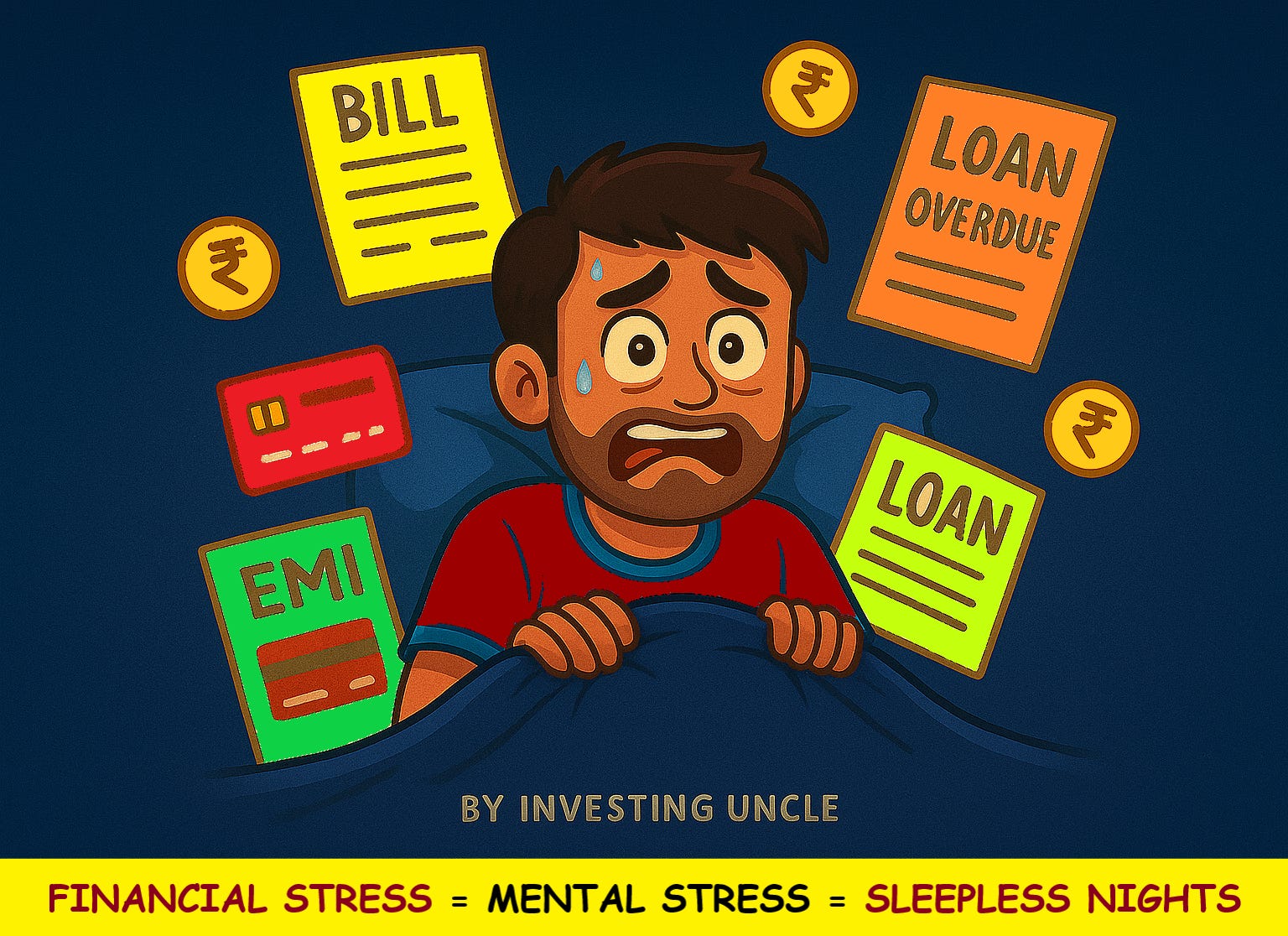
Bunny’s face looked like he had just checked his electricity bill after running the AC all summer.
Not sad, not shocked… but that deep, “Oh God, now what?” expression.
He whispered, “Uncle… I think my brain is permanently in EMI mode.”
If you’ve ever:
Opened your bank app and immediately closed it
Felt your heartbeat increase while hearing the word “loan”
Or fought with your spouse about “Why did you buy that?”
…then welcome to the silent epidemic: FINANCIAL STRESS.
OUR HERO & GUIDE
Hero = Bunny
Guide = Me, Investing Uncle - the chai-drinking, budget-loving uncle who explains money problems in plain language, with jokes included for free.
The Problem - Bunny is stressed, really stressed
One evening, Bunny landed at my balcony with two things - Samosas and a face that said, “Life is over.”
“Uncle,” he said, “I’m not sure if I’m broke or just permanently stressed. My head is spinning, my stomach is upset, and my salary disappears faster than a biscuit in chai.”
His list of worries was a full Bollywood drama:
Credit card bill pending
Mutual fund portfolio in red
Boss dropping hints about “cost efficiency”
And zero sleep for the past few weeks
Investing Uncle Listens
I handed him chai and said,
“Bunny, financial stress and mental health are like relatives at a wedding - one creates drama, the other joins in, and then they start dancing on your head together.”
Here’s the truth: It’s a two-way street.
If money is tight, your mind suffers.
If your mind suffers, you make worse money decisions.
A perfect “stress cycle” that spins faster than your washing machine.
The Balcony Chai Solution
I told Bunny, “We can’t make all problems disappear, but we can:
Reduce the chaos in your head
Make a small, doable plan
Build habits that protect your brain and your bank account”
Step 1: Spot the signs early
Mental stress doesn’t always shout - sometimes it whispers:
Feeling anxious or irritable all the time
Trouble focusing (you open Excel but end up reading about how cats sleep 18 hours a day)
Headaches, stomach issues, or high BP
Fighting with friends/family about money
Losing sleep because your brain won’t stop talking
Step 2: Break the loop
Write your worries down (your brain is not a storage device)
Separate urgent from important
Take one money decision at a time - slow is smooth, smooth is fast
Step 3: Watch out for “fake comfort”
Many people deal with stress by:
Overspending (“I deserve this phone!”)
Avoiding reality (“I won’t check my bank balance till next month”)
Both are traps: short-term comfort, long-term pain.
Step 4: Strengthen the money-mind link
Learn basic personal finance - remember our blog “How much return should I expect from mutual funds?” That’s a good starting point for financial calm.
Keep a small emergency fund so life’s surprises don’t knock you over.
Don’t ignore mental health - free helplines and low-cost counselling exist. Use them.
Bunny’s eyes open
Bunny realised:
Stress was making him take poor decisions
Poor decisions were making his money situation worse
And both were ruining his health
…he stopped blaming “bad luck” and started building a plan.
“Uncle, so it’s not just about saving money, it’s about saving my mind too?”
“Exactly. If your brain is tired, your money will never work properly. The driver must be alert before the car can go anywhere.”
Transformation: Bunny takes control
Over the next month:
Bunny tracked his expenses for the first time in years
Prepaid a small part of his EMI
Cancelled two useless subscriptions
Started evening walks to clear his head
Was he stress-free? No.
Was he in control? Yes.
And that’s a win.
If you’re reading this and thinking,
“This sounds somewhat like my life,”
remember - if Bunny can turn the corner with a plan… so can you.
A big part of stress reduction is having realistic expectations from your money. That’s why my blog “How much return should I expect from mutual funds?” is like mental therapy for your portfolio.
Today, Bunny still visits me for chai… but now we discuss cricket scores, not credit card scores.
He’s proof you don’t need a big bank balance to feel mentally rich.
“Money problems are like leaky taps - the earlier you fix them, the less they flood your life.”
What’s the one money worry that keeps you up at night? Share it in the comments - maybe Bunny and I can help.
See you My Hero, every Sunday at 09:15 AM.
Hope this blog adds real value to your long-term investing journey.
If YES, Maybe you treat Uncle with a cup of Tea?
Disclaimer: Mutual fund investments are subject to market risks, read all scheme related documents carefully before investing. The past performance of the mutual funds is not necessarily indicative of future performance of the schemes. Investors are requested to review the prospectus carefully and obtain expert professional advice with regard to specific legal, tax and financial implications of the investment/participation. This blog/Website is for Educational purpose only. Any reference should not be treated as any form of Financial Advice.
Any person referred to in this post is purely coincidental. The characters, names, and situations mentioned are for illustrative and educational purposes only and are not intended to represent any real individual.
‘Investing Uncle’ is NISM Series V-A Certified (Mutual Fund Distributor’s Certification Examination) conducted by National Institute of Securities Markets (NISM).
Investing Uncle is not SEBI/AMFI Registered.