

One Evening… Bunny Looked at His Bank Account and Felt… Strange
Bunny was standing quietly.
Phone in one hand.
Tea in another.
Bank balance open on screen.
₹5,13,442.
And somehow…
Instead of happiness…
He felt tension.
Not because he had no money.
But because he had no idea what to DO with it.
He whispered softly:
“Uncle… this money is just sitting in my savings account for many years.”
Investing Uncle looked at him.
Then smiled.
Then took one slow SIP of Tea.
And said:
“Bunny… many people treats savings account like a family locker.”
“Money goes inside…”
“And then nobody knows what to do next.”
Bunny laughed.
Because somewhere…
His ₹5 lakh had been doing permanent residency inside the same account for years.
Meet Our Story Characters
Our Hero: Bunny – A simple salaried man, disciplined enough to save ₹5 lakh… but completely confused about what to do with it next.
Our Guide: Investing Uncle – A calm, wise, and hilariously practical; the kind of person who explains investing using Tea and real life examples instead of complicated charts and PowerPoint slides.
The Confusion Nobody Talks About
Most of us are not taught what to do AFTER saving money.
We only hear:
Save more.
Don’t waste money.
Keep money safe.
Open a Fixed deposit.
Stock market is dangerous.
Mehra ji’s son lost lakhs in Stock Market.
And somewhere between fear and greed…
People freeze.
Money sits in savings account for years.
Slowly losing value.
Quietly.
Silently.
Like vegetables forgotten in fridge.
First… Just Relax
Investing Uncle leaned back.
“Bunny… listen carefully.”
“₹5 lakh sitting in savings account is NOT a problem.”
“It is actually a very beautiful beginning.”
Most people are struggling with:
EMI pressure
Credit card debt
No emergency fund
No savings
Salary-to-salary survival
So first…
Be grateful.
You have created something important.
Now the goal is simple:
Not to become rich overnight.
But to avoid stupid mistakes each and every day.
The Biggest Mistake? Leaving Everything in Savings Account Forever
Uncle took Bunny’s phone.
Opened calculator.
Then said:
“Most savings accounts in India give around 2-3% interest.”
“But inflation in India usually stays around 6-7% or even higher.”
Bunny blinked.
“Meaning?”
Uncle smiled.
“Meaning your money looks safe…”
“But its purchasing power is quietly shrinking.”
Then Uncle pointed toward Bunny’s tea.
“Today Tea is ₹20.”
“Yesterday it was ₹10.”
And…
“Tomorrow it will be ₹30.”
“But your money in Savings Account is standing still.”
Bunny sighed.
“So savings account is bad?”
“No Bunny.”
“Savings account is excellent…”
“For parking.”
“But, Not for long-term wealth creation.”
Before Investing Even ₹1… Ask THESE Questions
“Bunny… before choosing any investment…”
“You must first choose the PURPOSE.”
Because investing starts with goals.
Not schemes.
Not apps.
Not Social Media thumbnails showing Super cars.
Not ‘guaranteed 40% returns’.
Goals - first.
Products - second.
Then Uncle gave Bunny a notebook.
And wrote:
Ask Yourself Honestly
After how many years, do I need this money?
Is this emergency money?
Is this for marriage?
House down payment?
Child education?
Parents’ healthcare?
Retirement?
Business?
Can I tolerate market falls?
Will I panic if market drops 20-30% tomorrow?
Do I have EMIs?
Do I already have insurance?
How stable is my job?
“Bunny…”
“Correct investing is less about intelligence…”
“And more about self-awareness.”
Step 1 — Emergency Fund Comes BEFORE Investing
Bunny asked:
“So should I put entire ₹5 lakh in stock market?”
“No Bunny, not at all…”
“Emergency fund first!”
Emergency Fund is NOT Investment Money
This is life protection money.
Not return-generating money.
Not excitement money.
Not crypto money.
Not ‘friend ka startup’ money.
Emergency fund protects you from:
Job loss
Medical emergencies
Sudden family expenses
Business slowdown
Unexpected repairs
Salary delays
How Much Emergency Fund?
Uncle explained simply.
“If your monthly family expenses are ₹50,000…”
Then ideally keep:
Minimum = ₹3 lakh
Better = ₹6 lakh
That means 6-12 months of expenses.
Where Should Emergency Fund Stay?
Keep it:
Liquid
Accessible
Safe
Best beginner options:
Savings account
Liquid mutual funds
Not:
Stocks
Crypto
Equity funds
Locked investments
Because emergency money must be available FAST.
Hospital bills do not wait for market recovery.
(Note: Uncle’s own Emergency Fund is in Instant Redemption Liquid Funds)
Step 2 — Clear Dangerous Debt FIRST
Uncle suddenly leaned forward dramatically.
“Bunny…”
“If you are paying 36% credit card interest…”
“And trying to earn 12% from investing…”
“You are financially doing push-ups inside a swimming pool.”
Bunny laughed loudly.
But understood immediately.
Clear These First
Before aggressive investing:
Credit card debt
Personal loans
Buy-now-pay-later debt
App loans
High-interest consumer loans
Because:
Credit card interest can be 30–40%
Personal loans often 12–18%
No safe investment consistently beats that risk-free.
Step 3 — Buy Proper Insurance
Uncle became calm again.
“One hospital bill can destroy years of savings.”
And sadly…
This is true in India.
Health Insurance First
Especially if:
You have family responsibilities
Parents depend on you
You are self-employed
Your company insurance is weak
Because your ₹5 lakh should build wealth.
Not disappear inside hospital walls.
Term Insurance
If family depends on your income:
Buy term insurance.
Simple.
Cheap.
Pure protection.
Not fancy insurance-investment combo products sold emotionally by relatives and your Bank RM.
Uncle whispered dramatically:
“Insurance is not investment.”
“It is financial helmet.”
Now Comes the Real Question…
What Should You ACTUALLY Do With ₹5 Lakh?
Investing Uncle smiled.
“Now Bunny…”
“We divide money according to your TIME HORIZON.”
Because:
Time frame changes everything.
The Golden Framework Every Indian Should Understand
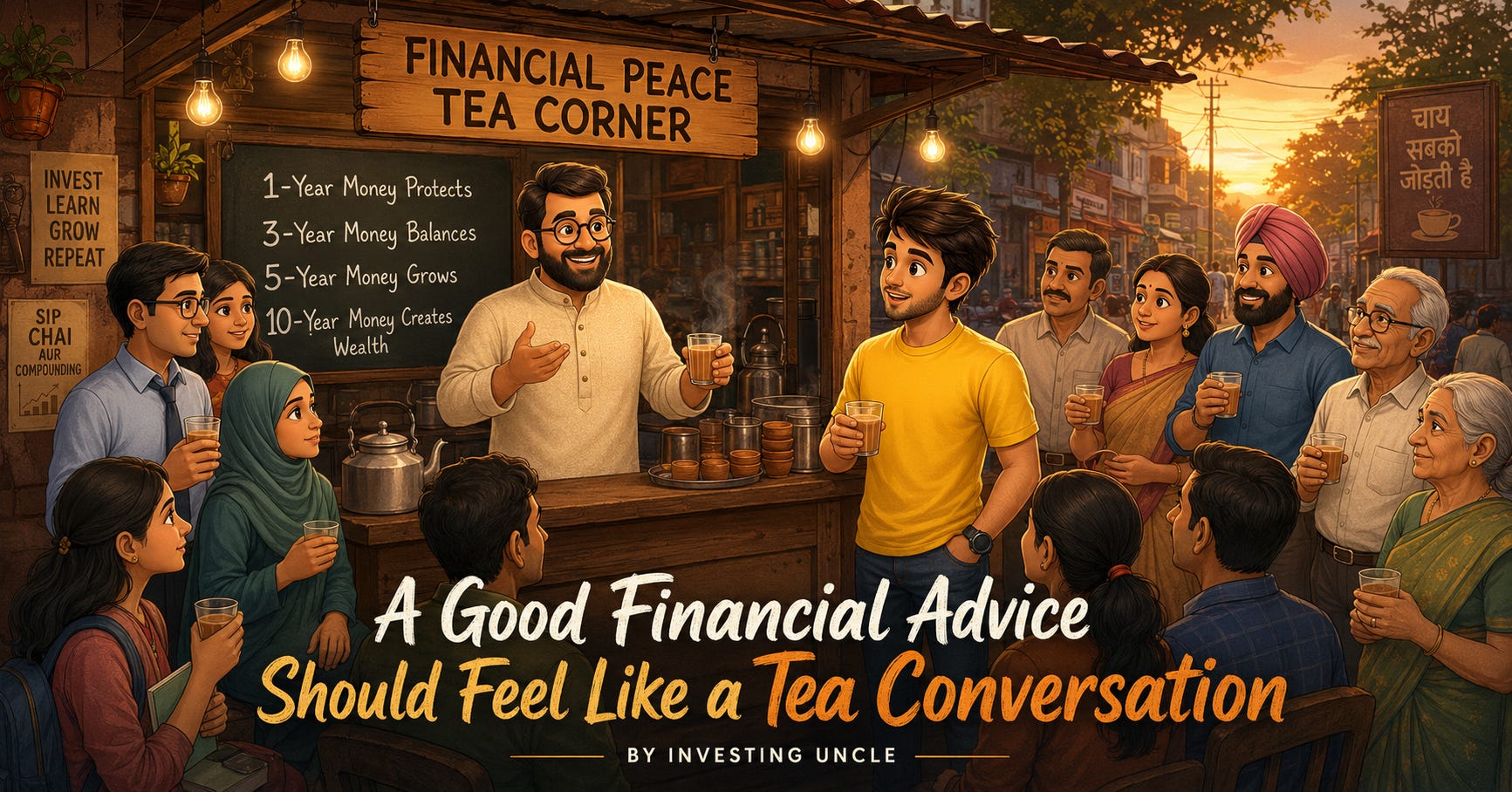
Uncle wrote:
1-Year Money Protects
3-Year Money Balances
5-Year Money Grows
10-Year Money Creates Wealth
Then he smiled proudly.
“Simple?”
Bunny nodded.
“Very.”
If You Need the Money Within 1 Year
Example goals:
Marriage expenses
House booking amount
Travel
Emergency reserve
Business payment
Then your priority is NOT huge returns.
Your priority is:
Capital Protection
Meaning:
Do not lose money.
Good Options for 1-Year Money
Bank FD
Liquid mutual funds
Avoid heavy equity exposure.
Because markets can fall suddenly.
And short-term money should not become emotional trauma.
If Your Time Horizon is Around 3 Years
Now we can take slightly more growth.
But still carefully.
Balanced Allocation Works Better
Example approach:
Part in short term debt funds
Part in conservative hybrid mutual funds
Hybrid funds mix:
Equity
Debt
This helps reduce volatility compared to pure equity.
Uncle explained beautifully:
“Hybrid funds are like Indian parents.”
“A little strict.”
“A little supportive.”
“Balanced.”
If You Can Stay Invested for 5-7+ Years
Now equity mutual funds start making real sense.
Because equity needs:
Time
Patience
Discipline
Not daily checking.
Not panic.
Not drama.
Start SIMPLE — Especially As Beginner
“Bunny…”
“You do NOT need to become Warren Buffett by Next Sunday, 09:15 AM.”
Best Beginner-Friendly Option?
Broad Market Based Diversified Index Funds
Why?
Because index funds:
Are simple
Have low cost
Automatically invest in large Indian companies
Reduce stock-picking stress
Uncle smiled.
“Index funds are like ordering thali.”
“You don’t need to choose every vegetable individually.”
Never Put Entire ₹5 Lakh in One Place
Very important.
Do NOT put all money into:
One stock
One sector
One friend’s business
Crypto
Trading
Small-cap hype
Themed funds
Sectoral funds
Why Diversification Matters Emotionally
Uncle explained softly.
“When one investment falls…”
“You don’t feel like your entire life is collapsing.”
That emotional stability matters.
Because panic destroys more wealth than market crashes.
The Biggest Risk is NOT Market Crash
Bunny looked surprised.
“Really?”
“Yes.”
“The biggest long-term risk is panic-selling.”
People invest during excitement.
Then market falls 10-20-30%.
Then they panic.
Sell everything.
And permanently damage wealth creation.
Equity Reality…
“Long-term investment in equity may give around 12% CAGR historically.”
“But in the short term?”
“Market can fall 20–30% easily.”
This is normal.
Not emergency.
Not apocalypse.
Not end of India.
Not Thanos invading Earth.
Just market behaving like market.
So How Should Beginner Invest ₹5 Lakh?
Uncle smiled.
“Slowly.”
Not emotionally.
Not dramatically.
Use STP Instead of Investing Full Lump Sum Immediately
What is STP?
Systematic Transfer Plan.
Simple meaning:
Keep money temporarily in liquid fund
Transfer fixed amount monthly into equity fund
Example:
₹5 lakh in liquid fund
Transfer ₹25k–₹50k monthly into index fund
Benefits:
Reduces timing risk
Reduces emotional stress
Helps beginners stay calm
Also Start SIP Alongside
This is important.
Wealth is usually built through:
Consistent monthly investing
Even:
₹5,000 SIP
₹10,000 SIP
₹15,000 SIP
Done consistently for years…
Can become powerful.
Wealth Creation Looks Boring
Uncle smiled.
“Real investing is not exciting.”
“It is repetitive.”
It looks like:
SIPs
Patience
Ignoring noise
Staying invested
Sleeping peacefully
Not:
Flashy screenshots
Daily trading
Social Media tips
‘Upper circuit tomorrow’ messages
Align Investments With Your Emotional Comfort
This is very important.
If market falls make you anxious…
Reduce equity allocation.
Even for long term.
There is no prize for emotional suffering.
Good investing is sustainable investing.
Avoid Social Media Financial Fantasy
Uncle suddenly looked annoyed.
“Bunny…”
“Never invest because some finfluencer showed a supercar beside candlestick chart.”
Social media usually shows:
Profits ONLY.
Screenshots
Luxury
Fast money
Nobody shows:
Losses
Anxiety
Debt
Regret
Emotional breakdowns
Remember:
Investment in securities market is subject to market risks.
And “guaranteed high returns” usually means danger nearby.
Common Mistakes WE Make With Idle Money
Uncle began counting on fingers.
Mistake 1 — Keeping money in savings account forever
Feels safe.
But inflation quietly eats purchasing power.
Mistake 2 — Investing entire amount during excitement
Then panic-selling during crash.
Mistake 3 — Chasing hot themes
IT.
Defense.
Pharma.
Crypto.
AI.
Whatever is trending.
Mistake 4 — Giving money emotionally to friends/relatives
Without documentation or without keeping something as collateral.
Then relationships and money both disappear.
Mistake 5 — F&O Trading
Many beginners lose years of savings here.
Mistake 6 — Investing without goals
Every rupee should have a job.
Give Every Rupee a Purpose
Uncle continued:
Safety Money
Emergency Money
Retirement Money
Opportunity Money
Parents’ Healthcare Money
House Money
Vacation Money
Money without purpose becomes confusion.
Money with purpose becomes peace.
Example Beginner Allocation for ₹5 Lakh
Bunny finally asked:
“Okay Uncle…”
“Tell me practically.”
Uncle smiled.
“Fine.”
Example ONLY (Not Universal)
₹1.5–2 lakh
Emergency fund
Keep in:
Savings account
Liquid fund
₹50k–₹1 lakh
Insurance + short-term funds
Remaining amount
Gradually move into:
Large-cap index funds
Through STP or phased investing
And continue SIP from monthly salary over multiple decades.
What If You Are Still Confused?
Then start small.
Learn slowly.
Increase gradually.
You do NOT need perfect strategy immediately.
You need sensible direction.
Even 2–3 months of learning basic investing can prevent years of mistakes.
Learn:
Inflation
Asset allocation
SIP
Risk
Time is Your Biggest Asset
“Bunny…”
“If you are young…”
“This ₹5 lakh can become surprisingly powerful over 10-20-30 years.”
Because wealth creation needs only 3 things:
Time
Consistency
Calmness
That’s it.
Bunny Asked the Most Important Question
“Uncle…”
“So what is the REAL goal of investing?”
Investing Uncle smiled softly.
And said:
“Becoming financially unbreakable.”
Silence.
Even Bunny stopped joking for a moment.
More Important Things…
If you have:
Complex goals
Family responsibilities
Confusion about asset allocation
Tax planning issues
Then consult:
A SEBI-registered investment advisor
ORA trusted Mutual Fund distributor
Good advice can save years of mistakes.
Wisdom From Our Earlier Tea Conversations
If this blog helped you…
You should also read:
“Money and Mindfulness: How Indian Families Build Financial Peace”
Because wealth without peace becomes stress wearing expensive clothes.
And also read:
“20 SIP Mistakes That Destroy Long-Term Wealth”
Because investing success is often less about brilliance…
And more about avoiding avoidable mistakes.
The Transformation of Bunny
Three months later…
Bunny looked different.
Not richer.
But calmer.
Smarter.
More organized.
He had:
Emergency fund
Insurance
STP running
SIP started
Goals written clearly
Less panic
Less confusion
And for first time…
He stopped treating money like mystery.
He started treating it like responsibility.
And slowly…
Confidence replaced fear.
And Surely… This Is Your Turning Point Too
Your ₹5-10-20 lakh is not “idle money.”
It is the beginning of:
Stability
Discipline
Family security
Long-term wealth
Peace of mind
Wealth creation is usually not one big decision.
It is many calm decisions repeated for years.
Final Tea Conversation
Bunny smiled softly.
“Uncle…”
“So investing is actually simple?”
Investing Uncle smiled.
“Simple?”
“Yes.”
“Easy?”
“No.”
Then he took one final SIP of Tea.
And said:
“The market rewards patience more than intelligence.”
And maybe…
Somewhere while reading this…
You smiled too.
Because deep down…
You already knew…
You don’t need magic.
You need clarity.
And now…
You finally have some.
“Money grows best in hands that stay calm during noise.”
One Tiny Request From Investing Uncle
Nowadays people happily spend ₹300 on cold coffee…
But hesitate to support the person helping them avoid ₹5 lakh mistakes.
Strange species, human beings.
So if this blog genuinely helped you think better about your Idle money.
Treat Uncle with a small cup of tea.
Not because Uncle needs tea.
But because good financial education should survive longer than fake finfluencer reels.
And sometimes…
Supporting honest voices is also an investment.
Before You Go…
Comment below:
If YOU had ₹5 lakh today…
What would YOU do with it first?
Emergency fund?
FD?
Index funds?
Clear debt?
Buy peace of mind?
And subscribe now if you want more calm, practical, middle-class financial wisdom every Sunday.
Because next Sunday at 09:15 AM…
Investing Uncle will again arrive with Tea in hand…
And another money confusion quietly waiting to be solved.
Related Reads…
Money and Mindfulness: How Indian Families Build Financial Peace.
Compounding: The 8th Wonder of the World for Wealth Creation
Disclaimer: Mutual fund investments are subject to market risks, read all scheme related documents carefully before investing. The past performance of the mutual funds is not necessarily indicative of future performance of the schemes. Investors are requested to review the prospectus carefully and obtain expert professional advice with regard to specific legal, tax and financial implications of the investment/participation. This blog/Website is for Educational purpose only. Any reference should not be treated as any form of Financial Advice.
Any person referred to in this post is purely coincidental. The characters, names, and situations mentioned are for illustrative and educational purposes only and are not intended to represent any real individual.
‘Investing Uncle’ is NISM Series V-A Certified (Mutual Fund Distributor’s Certification Examination) conducted by National Institute of Securities Markets (NISM).
Investing Uncle is not SEBI/AMFI Registered.
Please consult a SEBI or AMFI-registered financial professional before making any investment decisions in the securities market.
Calm Investing with Uncle — Through Market Ups and Downs.